50m vs 25m Pools: Which Should You Choose for a Swim Camp?
Short answer: choose a 50m pool if your next important competitions are long course, if swimmers need qualifying times in a 50m pool, or if the camp is an aerobic block before the summer season. Choose a 25m pool if your main meets are short course or the group is young and still working on turns, starts and technique. Many clubs book a 50m pool and use it for both.
Pool length is one of the first questions we ask when a club requests a swim camp, and one of the easiest to get wrong. This guide is for head coaches, team managers and parents’ committees comparing destinations. It explains what really changes between a 50-metre and a 25-metre pool, how to match the choice to your competition calendar, and what to check in an offer before you sign.
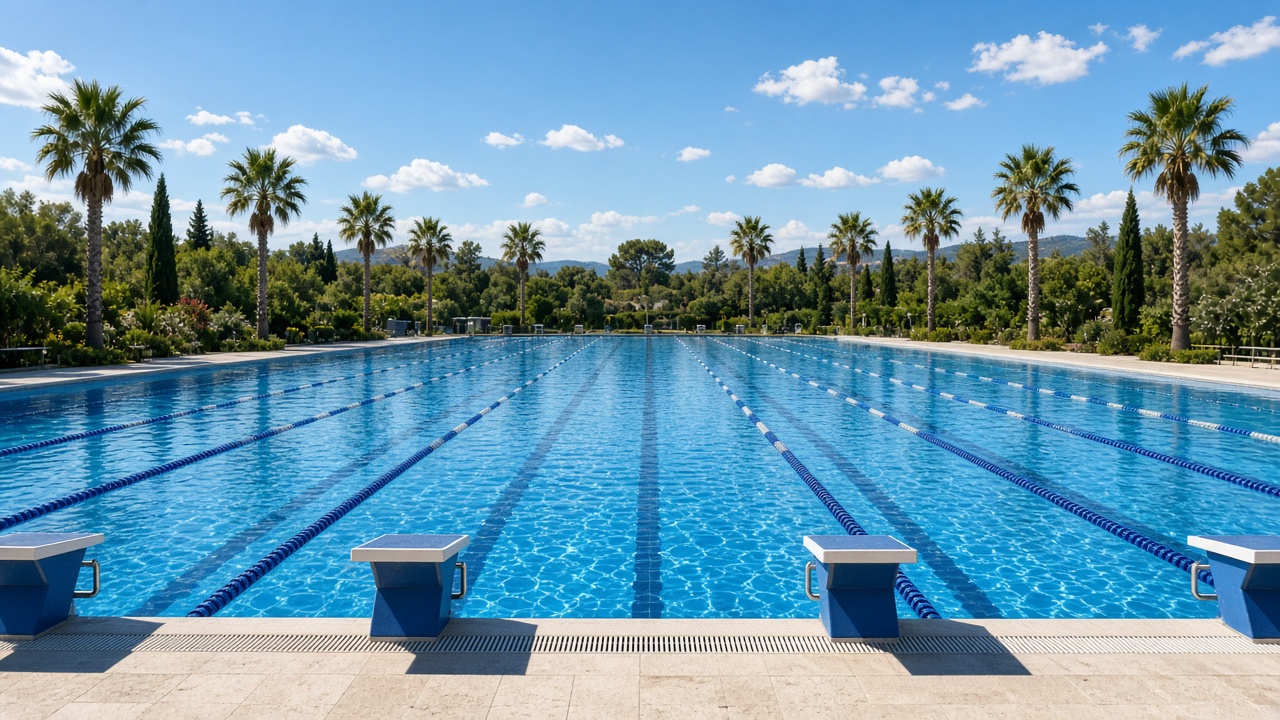
50m vs 25m pools compared
World Aquatics recognises results in both formats: long course metres (LCM, a 50m pool) and short course metres (SCM, a 25m pool). The Olympic Games are swum long course, while World Aquatics also runs a separate short-course world championships. The main differences for training are summarised below.
| Factor | 50m pool (long course) | 25m pool (short course) |
|---|---|---|
| Competition format | Olympic Games, long-course championships and most summer meets | Short-course meets, often in the autumn and winter season in Europe |
| Turns in a 200m swim | 3 | 7 |
| Training effect | Longer stretches of uninterrupted swimming, holding stroke rate and pace without a wall every 25m | More starts, turns and underwater phases per session; good for skill work and race-specific short-course speed |
| Times | Usually slower than short course for the same swimmer and distance | Usually faster, because every wall gives a push-off |
| Best fit | Older age groups, distance swimmers, pre-summer blocks, long-course qualifying | Younger swimmers, technique camps, preparation for short-course meets |
| Typical camp setup | Reserved lanes in an outdoor or indoor Olympic-size pool, often in warm-weather destinations | Reserved lanes in an indoor pool; sometimes a 50m pool divided by a movable bulkhead |
Start with your competition calendar
The simplest rule is to train in the format of your next important meet. In many European countries the club season is split into a short-course part in the autumn and winter and a long-course part in the spring and summer, but calendars differ between federations, so check yours. A camp in February or March, six to ten weeks before the first long-course meets, is a classic time to get swimmers used to 50m lengths again. A camp in October or November ahead of short-course championships can make good use of a 25m pool.
Qualifying is the second question. If swimmers are chasing long-course qualifying times, they need regular race-pace work over 50m lengths, and federations have their own rules on whether times or conversions from short course count. Check before you decide.
Then look at the pool configuration
“A 50m pool” says little on its own. What matters for a camp is how many lanes you get, how many swimmers share each lane, for how many hours, and whether the pool is indoor, outdoor or heated. Examples from current Gothia Sportstravel swim camp offers:
- El Albir, Costa Blanca (Spain): 50m outdoor pool with 10 lanes at 27°C, 4 hours of pool training per day with 6–8 swimmers per lane. 8 nights with full board from €813 per person in a triple room (January–February).
- Glyfada, Athens (Greece): heated 50m pool with 8 lanes, 800 metres from the hotel, 10 sessions of 2 hours with 6–8 swimmers per lane. 7 nights from USD 1,182 per person in a triple room for groups of 32–36.
- Paphos (Cyprus): 50m Olympic pool 200 metres from the hotel, 12 sessions of 2 hours with a maximum of 7 swimmers per lane. 7 nights all-inclusive from €1,090 per person in a triple room.
- Brønderslev (Denmark): training in a 50m pool 1 km from the sports centre, with full board in shared rooms. 5 nights from €460 per person.
These are example prices from Gothia Sportstravel offers. They exclude flights, and they vary by dates and group size. In some destinations pool time is not part of the package but booked per lane and hour. In our Torremolinos offers, for example, lane hire is charged separately per lane and hour. Always compare offers on the same basis: lanes, hours per day, swimmers per lane and what is included.
Decision matrix: which pool fits your camp?
| Your situation | Recommended pool | Why |
|---|---|---|
| Next main meet is long course (spring or summer) | 50m | Swimmers rehearse race pace, pacing and stroke count over 50m lengths |
| Next main meet is short course (autumn or winter) | 25m, or a 50m pool with some 25m work | More turns and underwater work at race speed |
| Swimmers chasing long-course qualifying times | 50m | Training in the format the times must be swum in |
| Young swimmers or a technique-focused camp | 25m works well | Shorter lengths, more feedback from the coach at each wall, more turn practice |
| Distance and open-water swimmers | 50m | Long sets with fewer interruptions |
| Mixed squad with several age groups | 50m with enough lanes | Lanes can be split by group; check whether part of the pool can be used short course |
| Tight budget or a short camp close to home | Whichever offers enough lane time | Lane hours and swimmers per lane affect the quality of training more than length alone |
Questions to ask before you book
- Is the pool 50m or 25m, indoor or outdoor, and what is the water temperature?
- How many lanes are reserved for us, and are they exclusive or shared with the public or other clubs?
- How many swimmers per lane, and how many hours per session and per day?
- Are pool hours included in the package or charged per lane and hour?
- How far is the pool from the hotel, and is transport needed?
- Are there a gym, space for dryland training and starting blocks we can use?
If you are building a budget at the same time, our swimming training camp cost breakdown explains what clubs typically pay for and where the savings are.
Our conclusion
For most competitive club squads, a 50m pool is the safer choice for a training camp: it covers long-course preparation, and most swimmers get less 50m water at home than they would like. Pick a 25m pool when your next target is a short-course meet or the camp is about technique for younger swimmers. Whichever length you choose, lane hours and swimmers per lane matter as much as the pool itself. See our swimming training camps for destinations with 50m and 25m pools. Gothia Sportstravel gives every booking a personal contact person, so tell us your dates, group size and competition plan and we will suggest a pool setup that fits.
